What Tests Are Needed Before ICL, SMILE or Cataract Surgery?
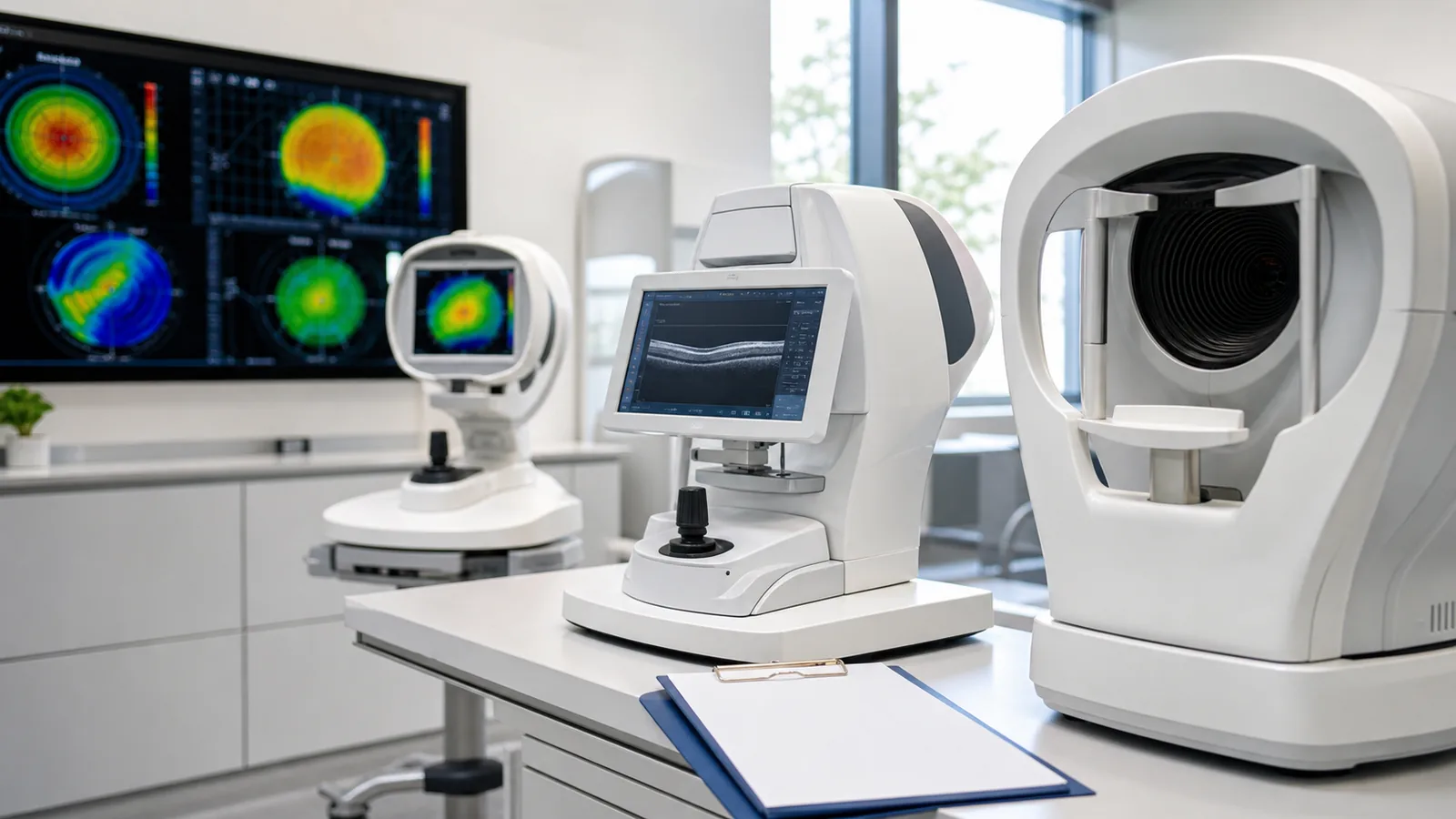
Original CareNavigator AI-generated editorial image.
Quick Answer
Before ICL, SMILE, LASIK or cataract surgery, an ophthalmology team usually needs more than a glasses prescription. The assessment may include refraction, corneal mapping and thickness, ocular-surface review, eye-pressure measurement and a dilated retinal examination. ICL planning adds measurements such as anterior-chamber depth and endothelial-cell count. Cataract planning requires biometry to estimate lens power.
The exact test set depends on the procedure, the patient’s eye health and the hospital’s protocol. Some measurements must be completed or repeated on the treating institution’s equipment before a final recommendation can be made.
Key Takeaways
- A routine glasses test is not a complete surgical assessment.
- Different procedures require different anatomical measurements.
- Contact lenses can affect measurement accuracy, so preparation instructions matter.
- The preferred procedure or lens may change after in-person testing.
- Testing and surgery should not be assumed to happen on the same day.
- Ask whether assessment fees and repeat tests are included in the quotation.
Which Tests Are Common Across Eye-Surgery Pathways?
| Assessment | What it helps the clinical team understand |
|---|---|
| Medical and eye history | Previous surgery, eye disease, medications, general health and current symptoms |
| Refraction | The current prescription and whether it appears stable |
| Slit-lamp examination | The front structures of the eye, including the cornea and natural lens |
| Eye pressure | Whether pressure findings require further review |
| Ocular-surface assessment | Dry-eye or surface findings that may affect measurements, comfort or planning |
| Dilated retinal examination | The retina and optic nerve, especially when high myopia or other risk factors are present |
Additional imaging or specialist review may be required when the assessment finds a concern involving the cornea, retina, glaucoma, ocular surface or another part of the eye.
What Tests Are Often Discussed Before SMILE or LASIK?
Corneal laser procedures require a detailed understanding of the cornea and the prescription being treated.
Common assessment areas include:
- Manifest refraction and, when clinically indicated, cycloplegic refraction
- Corneal topography or tomography
- Pachymetry, which measures corneal thickness
- Pupil assessment
- Ocular-surface and dry-eye evaluation
- Eye pressure
- Dilated retinal examination
Topography and tomography map aspects of corneal shape. Pachymetry measures thickness. These tests help the ophthalmologist assess whether a corneal procedure should be discussed and whether another finding needs attention first.
A patient should not use one measurement, such as corneal thickness, to choose a procedure independently. The clinical interpretation depends on the complete examination.
What Additional Tests May Be Needed Before ICL?
ICL is a lens-based refractive procedure in which a phakic lens is placed inside the eye while the natural lens remains.
In addition to the broader eye examination, the clinical team may assess:
- Anterior-chamber depth and related anatomy
- Endothelial-cell density
- Angle and pupil measurements
- Refraction and prescription stability
- Eye pressure
- Retinal health
- The lens power and model being considered
These measurements help determine whether an ICL pathway can be considered and which lens specification may be relevant. They also support later monitoring.
An online discussion or previous prescription may help a hospital decide whether a case is worth reviewing, but final suitability normally depends on in-person measurements.
What Is Tested Before Cataract Surgery?
Cataract surgery planning requires measurements used to select an intraocular lens, as well as an assessment of other eye conditions that may affect the expected visual result.
Biometry commonly includes:
- Axial length, measuring the length of the eye
- Corneal power or keratometry
- Anterior-chamber and related measurements
- Lens calculation inputs
Corneal mapping, retinal imaging or other testing may be added when the clinical team needs to evaluate irregular corneal measurements, retinal health, glaucoma or another concern.
Lens selection is not based only on price or the label “premium.” Monofocal, toric, multifocal, trifocal and EDOF lenses involve different visual goals and trade-offs. The discussion should follow the examination.
Why Might Measurements Need to Be Repeated?
Repeat testing does not necessarily mean that something has gone wrong.
Measurements may be repeated because:
- Contact lenses have temporarily changed the corneal surface or refraction
- The prescription is not stable
- Dry eye or another ocular-surface condition affects accuracy
- Two measurements do not agree
- Dilation or an additional examination is needed
- A retinal, corneal or glaucoma finding requires specialist review
- The planned procedure changes after the complete assessment
For an international patient, this is one reason to avoid booking an inflexible itinerary around a guaranteed surgery date.
How Long Should Contact Lenses Be Stopped?
There is no single stop period that applies to every lens and every hospital.
Soft, toric, rigid gas-permeable and orthokeratology lenses can affect measurements differently. Clinical studies and institutions use different preparation periods. The treating hospital should provide written instructions for the patient’s exact lens type before travel.
When asking for a review, tell the team:
- The lens type
- How many hours per day it is worn
- How long it has been used
- Whether it is worn overnight
- When it was last removed
Do not rely on a generic online number if the receiving clinic has not confirmed its protocol.
Can Some Tests Be Completed in Australia or New Zealand?
Existing reports may be useful for initial review, especially when they include recent refraction, corneal imaging, retinal assessment or previous surgery details.
However, the treating institution may still need to repeat measurements because:
- Equipment and measurement protocols differ
- The data are incomplete or outdated
- Lens wear has affected reliability
- The surgeon needs measurements obtained within the institution’s own workflow
- The patient’s condition has changed
Before travelling, ask which files should be sent, which formats are accepted and which tests will definitely be repeated in Shanghai.
What Should Be Included in the Assessment Quote?
Ask whether the quoted assessment fee includes:
- Specialist consultation
- Refraction
- Corneal topography or tomography
- Pachymetry
- Ocular-surface testing
- Eye-pressure measurement
- Endothelial-cell count
- Cataract biometry
- OCT, fundus photography or other retinal imaging
- Dilated examination
- Additional specialist review
- Copies of measurements and images
- English report
A low procedure price is difficult to evaluate when the diagnostic work is not itemized.
What Should Patients Bring to Shanghai?
Prepare:
- Current glasses and contact-lens prescriptions
- Details of the contact lenses being worn
- Previous eye-surgery records
- Recent eye reports and imaging
- A current medication list
- Relevant general medical history
- Details of diabetes, autoimmune disease or other conditions when applicable
- A concise list of the questions the family wants answered
These records support the review, but they do not replace the treating team’s examination.
Tell us which eye-care pathway you are considering and what testing has already been completed. CareNavigator can help identify established specialist pathways in Shanghai, clarify what information the hospitals need and coordinate a more useful case review before your family commits to travel.
Frequently Asked Questions
Is my glasses prescription enough for an online assessment?
It may support an initial discussion, but it is not a full surgical assessment. Corneal, retinal, pressure, ocular-surface and procedure-specific measurements may still be required.
What is corneal topography or tomography?
These tests map aspects of corneal shape. Ophthalmologists use them with other measurements when assessing corneal refractive procedures and investigating irregular findings.
Why is endothelial-cell count checked before ICL?
The corneal endothelium is relevant to ICL assessment and later monitoring. The treating ophthalmologist interprets the count together with the rest of the eye examination.
What is cataract biometry?
Biometry measures features such as eye length and corneal power that are used in intraocular-lens calculations. The final lens discussion also considers eye health and visual priorities.
How long should I stop wearing contact lenses?
The answer depends on the lens type and hospital protocol. Ask the treating institution for written instructions before booking the assessment.
Can testing and surgery happen on the same day?
It may be possible in some pathways, but it should not be assumed. Repeat measurements, ocular-surface findings, additional review, lens availability and scheduling can change the plan.
Source Notes
- FDA EVO ICL professional labeling
- AAO preoperative LASIK evaluation
- AAO cataract patient guidance
- National Eye Institute: dilated eye examination