Shanghai Doctors Use a 5G Remote Robot to Perform Kidney Cancer Surgery for a Patient in Tibet
Source-led CareNavigator update on remote robotic surgery and medical technology in China.
Quick Answer / What Happened
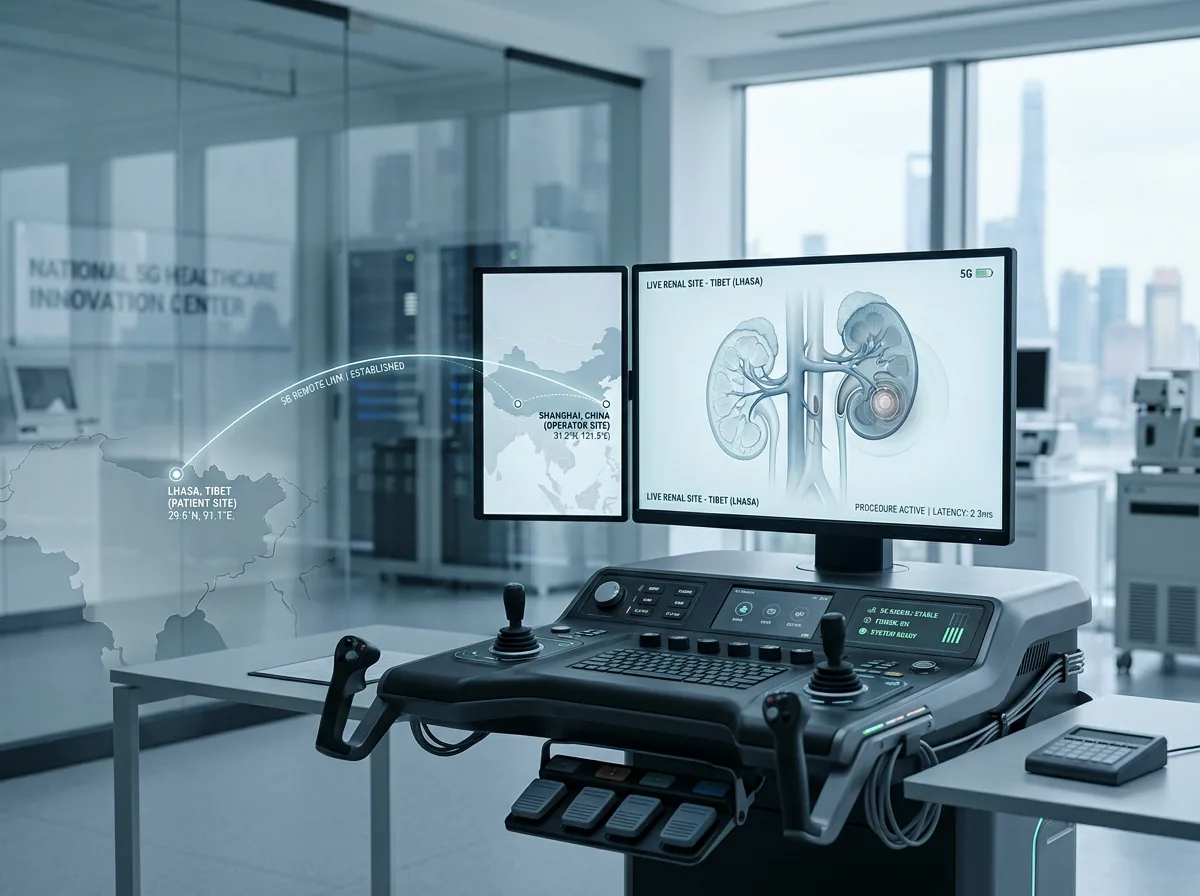
According to a Wenhui Daily report published through Shangguan News on June 10, 2026, a Shanghai urology team used a 5G remote robotic surgery system to perform robotic-assisted laparoscopic radical nephrectomy for a 63-year-old male kidney cancer patient in Shigatse, Tibet. The report stated that the operating physician was in Shanghai, while the robotic arm and local surgical team were in Shigatse, more than 4,000 kilometers away.
The report described the physical distance between Shanghai and Shigatse as 4,363.5 kilometers, and said the surgery used a high-bandwidth, low-latency 5G remote robotic surgery system.
Why This Matters
According to the report, the patient came from a pastoral area in Angren County, Shigatse, at an altitude of about 4,300 meters. His right-sided multiple malignant kidney tumors were discovered incidentally during care for another disease. Imaging suggested T3aN0M0 disease.
The report stated that the largest lesion was located at the renal hilum, an area described as a dense vascular hub. It said tumors in this region increase surgical complexity and risk because major renal vessels are concentrated there, and small deviations during surgery may cause serious bleeding.
The report also noted that this type of tumor was rare in Shigatse, and that the opportunity for minimally invasive laparoscopic radical surgery was especially valuable locally.
What International Patients Should Understand
The Wenhui Daily report described a multi-step consultation process before surgery. Shigatse People's Hospital first started a multidisciplinary consultation mechanism. Shanghai-supported urology experts and local clinicians held an initial MDT discussion to clarify surgical feasibility and potential risks. Later, experts in a Tibet regional urology multi-center difficult-case MDT meeting discussed the feasibility and precautions of using 5G remote robotic surgery.
The report said Shanghai Tenth People's Hospital then responded as the back-end support institution. Its urology MDT team, information department, remote medical center experts, and the Shigatse team held a joint Shanghai-Tibet MDT through a remote consultation platform. The teams discussed tumor positioning, renal hilar vessel protection, bleeding control during surgery, and postoperative recovery, and confirmed the plan for 5G remote robot-assisted laparoscopic radical nephrectomy.
What This Does NOT Mean
This report does not mean remote robotic surgery is suitable for every patient or every hospital setting. It describes one reported case involving a specific patient, surgical team, remote system, local hospital team, and technical environment.
How CareNavigator Can Help Patients Evaluate Relevance
For patients and families who see an update like this and wonder whether it may be relevant to their own situation, CareNavigator helps turn the news into a practical decision pathway. We help patients clarify their current diagnosis, treatment bottleneck, and decision point; compare whether China has relevant hospital, specialist, and technology options worth reviewing; coordinate case review with appropriate medical teams; and support the broader journey across hospital communication, pathway comparison, logistics, and follow-up planning. The final medical judgment remains with licensed clinicians and the responsible hospital team.
Surgical Course Reported By The Source
Before the operation, according to the report, the anesthesia team in Tibet completed anesthesia preparation. The local Shigatse team, Shanghai-supporting clinicians, and operating-room staff completed robotic system setup, debugging, and sterilization.
When the operation began, the report said surgical signals traveled through the 5G network to the robotic arm on the plateau. It described network latency as stable at the millisecond level, with zero packet loss, and said the operating physician felt almost no stutter.
In a 3D high-definition view magnified more than ten times, the report said the robotic arm moved with sub-millimeter precision, avoided large vessels in the renal hilar area, and removed the right kidney containing two tumor lesions. The report stated that blood loss was minimal, the patient's vital signs remained stable throughout, and after surgery the patient returned to the general ward for observation after monitoring in the anesthesia recovery room.
Tell us what your family is trying to decide. Contact CareNavigator and provide your diagnosis, current treatment situation, and key questions. CareNavigator can help you explore whether China has relevant hospitals, specialists, and treatment technologies worth reviewing, coordinate case review with appropriate medical teams, and support the next steps across hospital communication, pathway comparison, logistics, and follow-up planning.
Related CareNavigator Resources
- China Advanced Treatment Updates
- Why China
- How CareNavigator Helps
- China Treatment Navigation Guide
- How to Compare Cancer Hospitals in China Before You Decide
Source-Led Update Note
This article summarizes publicly available reporting and cited source materials about medical developments in China. It is not CareNavigator's independent clinical assessment of the therapy or technology and should not be read as medical advice for any individual patient. CareNavigator helps patients and families understand whether a reported China-based pathway may be relevant, compare options that may be worth reviewing, and prepare for informed conversations with qualified medical teams. Patient eligibility, risks, benefits, availability, and treatment decisions should be assessed by licensed clinicians and the responsible medical institution.
Source Notes
Primary media source: Wenhui Daily / 文汇报 article published through Shangguan News, titled "跨越4000多公里,上海医生通过远程5G机器人为西藏患者开展肾癌根治术", published 2026-06-10, author Li Chenyan.
Original URL shown in source materials: https://www.shobserver.cn/staticsg/res/html/web/newsDetail.html?id=1125881
Related Articles
- Renji Hospital Removes a 6.1-Kilogram Giant Breast Phyllodes Tumor in Shanghai
- EVO+ ICL (V5) in Shanghai: What International Patients Should Know About Technology and Cost
- Sanlian Lifeweek Reports How Brain-Computer Interface Research Is Helping a Spinal Cord Injury Patient Rebuild Daily Life in China