Sanlian Lifeweek Reports How Brain-Computer Interface Research Is Helping a Spinal Cord Injury Patient Rebuild Daily Life in China
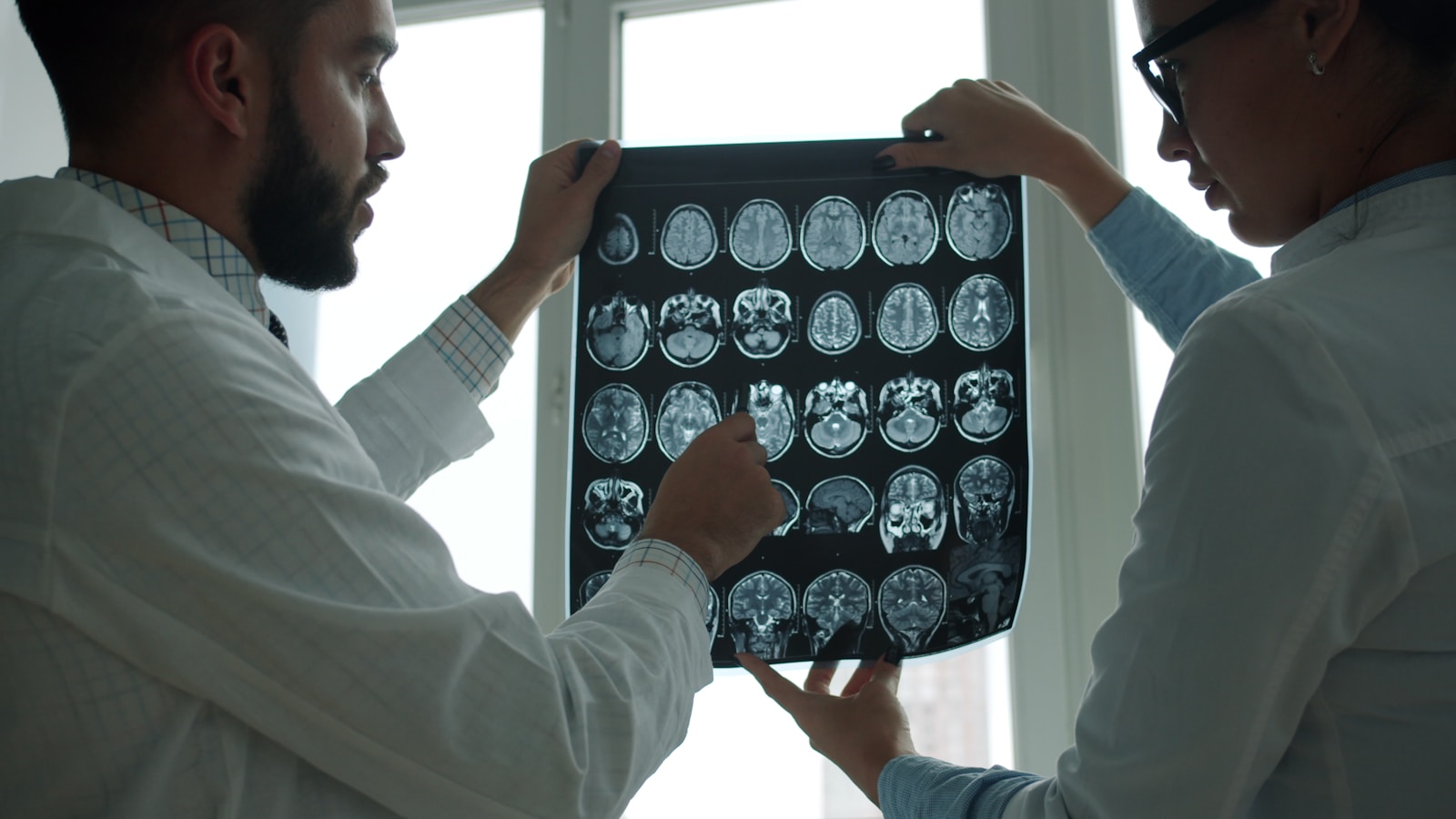
Two doctors examining a brain MRI scan together. Image: Vitaly Gariev / Unsplash.
Quick Answer / What Happened
According to a June 2026 Sanlian Lifeweek report, Chinese clinicians and researchers are exploring brain-computer interface technology for selected patients with severe neurological injury. The report followed Wang Zhiming, a man with lower-limb paralysis after a worksite accident, who received a semi-invasive brain-computer interface together with spinal cord electrical stimulation and exoskeleton-assisted rehabilitation at Xuanwu Hospital in Beijing. The report described this as an early clinical exploration, not a routine treatment pathway.
Why This Matters
The strongest part of the Sanlian report is not only the technology. It is the way the technology is connected to ordinary life.
Before the reported intervention, Wang had spent years largely confined to bed after a serious spinal cord injury. The report described the pain of the original accident, the loss of sensation below the waist, the need for catheter care, bowel-care support from his wife, repeated turning to prevent pressure sores, and the financial strain of long rehabilitation. For a young family with a mortgage and limited income, the injury changed not only mobility, but dignity, work, sleep, family roles, and confidence.
The report said Wang later learned online that brain-computer interface technology might be relevant to paralysis rehabilitation. After his family contacted Xuanwu Hospital, the hospital reviewed his case and he became one of a small number of patients included in an early-stage clinical study involving the semi-invasive brain-computer interface product known in the report as "Beinao No. 1." According to the report, he was the only patient with lower-limb paralysis among the seven patients enrolled in this first-phase feasibility study, selected from a pool of approximately 7,000 applicants who were evaluated.
According to the report, his system combined three elements: a brain-computer interface to identify movement intention, spinal cord electrical stimulation to increase responsiveness below the injury level, and an exoskeleton robot to support repeated walking-like training. The report emphasized that the process required surgery, device activation, rehabilitation, and repeated training - not a single procedure that immediately restored normal walking.
The Human Detail: Training Was Slow, Tiring, and Repetitive
The Sanlian report described Wang's rehabilitation in concrete terms. During training, he wore external equipment connected to the implanted system and practiced producing movement intention in his brain. If the intention was successfully decoded, the exoskeleton could help move his leg forward.
According to the report, one training set involved 20 steps, with sessions every morning and afternoon, totaling 5-6 hours of practice per day. In early sessions, Wang often could not "think it right" - the leg would not move, or only after many attempts. He said that even without walking far, his brain felt exhausted. At three months, he could produce three coordinated steps in a single thought and complete approximately 180 steps in one morning session. The source described this as a two-way adaptation: the decoding algorithm personalized to his brain signals as he practiced, and he in turn learned to produce clearer movement intentions. The training remained physically and cognitively demanding throughout.
This detail matters because it keeps the update grounded. The case was not presented as a simple technology miracle. It was a clinical and rehabilitation pathway requiring patient effort, family support, engineering adjustment, and long-term follow-up.
What International Patients Should Understand
The report places China's brain-computer interface work within a broader clinical and research context. It described Xuanwu Hospital's earlier involvement in brain-computer interface research, including non-invasive and semi-invasive approaches, and noted that Chinese hospitals and research institutions are increasingly active in this field.
The report also described important limitations. Clinicians quoted in the article said brain-computer interface surgery is not a magic switch. Patient selection is strict. Factors may include disease stability, preserved brain function, overall health, mental readiness, rehabilitation motivation, understanding, and family support. The report also noted that long-term safety, signal stability, decoding accuracy, payment, cost, and broader clinical adoption remain unresolved questions.
For international readers, the practical message is that China is not only developing advanced oncology and surgical pathways. Selected Chinese hospitals and research teams are also exploring complex neurological rehabilitation technologies. But this type of pathway remains highly case-specific and research-dependent.
What This Does NOT Mean
This reported case should not be read as evidence that brain-computer interface treatment is suitable or available for all patients with paralysis, spinal cord injury, stroke, ALS, or other neurological conditions.
It also should not be read as a promise that a patient can regain walking, hand function, speech, independence, or any specific outcome. The reported recovery details reflect one patient's diagnosis, clinical pathway, device system, rehabilitation effort, family support, and medical team.
How CareNavigator Can Help Patients Evaluate Relevance
For families following advanced medical developments in China, CareNavigator can help turn a news story into better questions.
We can help patients and families summarize the diagnosis and prior treatment history, clarify what decision they are trying to make, identify whether a China-based hospital or specialist pathway may be worth reviewing, and coordinate case review with appropriate medical providers when relevant.
For emerging technologies such as brain-computer interface research, the key is not to assume eligibility from a headline. The key is to understand whether the reported pathway has any relevance to the patient's actual condition, records, functional goals, travel readiness, and clinical review.
Contact us and tell us your situation. If your family is exploring advanced treatment or rehabilitation options in China, CareNavigator can help you organize the case, understand which China-based pathways may be worth reviewing, and prepare for informed conversations with appropriate medical teams.
Related CareNavigator Resources
- Why China
- How CareNavigator Helps
- Pathways Decision Library
- China Advanced Treatment Updates
- China Treatment Navigation Guide
Source-Led Update Note
This article summarizes publicly available reporting from Sanlian Lifeweek. It is not CareNavigator's independent clinical assessment of brain-computer interface technology and should not be read as medical advice for any individual patient. Patient eligibility, risks, benefits, availability, cost, and treatment decisions should be assessed by licensed clinicians and the responsible medical institution.
Primary source: Sanlian Lifeweek, published on WeChat on 2026-06-30. Original URL shown in the source note: https://mp.weixin.qq.com/s/vCrJrtjrnoKAsotZRv6HfA