CAR-T Cell Therapy in China: Costs, Access, and What International Patients Should Compare
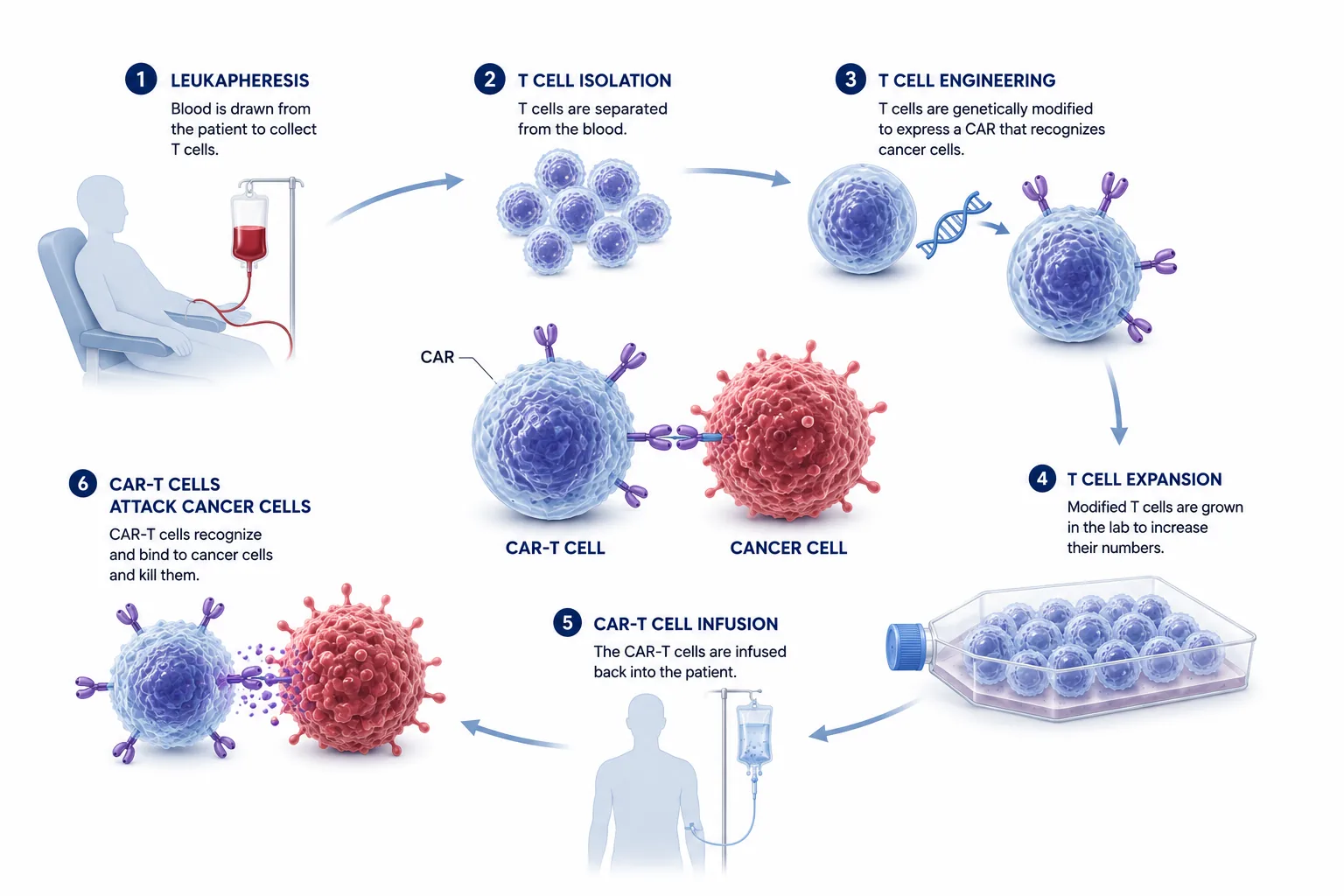
China is a global leader in CAR-T cell therapy, offering international patients access to advanced immunotherapy at a significantly lower cost than the US or Europe. With the world's largest number of ongoing clinical trials and multiple NMPA-approved products, China provides a credible destination for patients with relapsed or refractory blood cancers who have exhausted conventional options.
Direct answer
CAR-T therapy in China may be worth reviewing for selected patients with certain relapsed or refractory blood cancers, but it is not a general cancer treatment and is not suitable for every patient. International patients should confirm indication, prior lines of therapy, disease status, product availability, hospital capability, toxicity management, cost range, and follow-up planning through qualified specialist review before making travel decisions.
1. Why China is a Global Leader in CAR-T Cell Therapy
China's rapid ascent in cellular immunotherapy is driven by massive strategic investment and a high volume of clinical research. According to a review by Cao et al. (Frontiers in Immunology, 2025, DOI: 10.3389/fimmu.2025.1583116), China accounts for more than half of the registered CAR-T clinical trials globally as of April 2024.
Key Performance Indicators
- World-Leading Trial Volume: Over 600 registered trials in China targeting antigens such as CD19, BCMA, and novel solid tumor targets.
- Regulatory Approvals: The National Medical Products Administration (NMPA) has approved multiple commercial products, including Relma-cel and Axicabtagene Ciloleucel.
- Manufacturing Efficiency: Robust GMP facilities in China often achieve "vein-to-vein" times of 2–4 weeks, comparable to or faster than Western benchmarks.
2. Cost Comparison: China vs. USA and Europe
The financial accessibility of CAR-T therapy in China is a major factor for international families. While quality remains comparable to Western standards, total expenditure for CAR-T therapy in China is often significantly lower than in the US or Europe — with published estimates suggesting the differential can reach roughly 30–50% depending on the hospital and treatment protocol. Patients should request a detailed cost projection during their initial consultation.
Note: Total treatment cost includes hospitalization, apheresis, bridging therapy, and management of side effects like Cytokine Release Syndrome (CRS). Figures are 2025–2026 estimates.
3. Cancers Treatable with CAR-T in China
While research into solid tumors is ongoing, CAR-T therapy in China is most effective and widely available for hematological malignancies.
Approved and Common Indications
- B-cell Acute Lymphoblastic Leukemia (ALL): High remission rates in pediatric and young adult patients.
- Large B-cell Lymphoma (LBCL): Including DLBCL and primary mediastinal lymphoma.
- Multiple Myeloma: Targeting BCMA, showing significant success in relapsed cases.
- Mantle Cell Lymphoma (MCL): For adult patients who have failed prior therapies.
4. The Logistical Timeline: From Assessment to Recovery
Navigating a complex cellular therapy abroad involves multiple stages. Based on typical cases, the process from initial assessment to discharge often spans approximately 8–12 weeks — though individual timelines vary depending on the hospital, manufacturing schedule, and the patient's medical situation.
1.Initial Assessment (1–2 Weeks): Remote review of medical records by Chinese specialists to confirm suitability.
2.Travel & Intake (2 Weeks): Visa processing and arrival in China for in-person evaluation.
3.Cell Collection (Apheresis): A 4–6 hour procedure to collect the patient's T-cells.
4.Manufacturing (2–4 Weeks): T-cells are genetically modified and expanded in a GMP lab.
5.Infusion & Monitoring (3–4 Weeks): In-patient stay for the CAR-T infusion and monitoring for CRS or neurotoxicity.
For international patients considering CAR-T in China
International patients should treat CAR-T as a case-specific medical pathway, not a general treatment option. Before comparing hospitals, families should clarify:
- whether the cancer type and disease status match a CAR-T indication or trial pathway
- whether prior lines of therapy meet the reviewing team's criteria
- whether the patient is medically fit for travel, evaluation, cell collection, lymphodepletion, infusion, and monitoring
- which CAR-T product or trial pathway may be relevant, if any
- whether the hospital has experience managing cytokine release syndrome, neurotoxicity, infection risk, and inpatient monitoring
- what follow-up will be needed after returning home
CareNavigator can help organize records, prepare questions, coordinate communication, and compare practical pathways. It cannot determine eligibility, prescribe CAR-T, guarantee hospital acceptance, or promise outcomes.
Records usually needed for CAR-T review
A CAR-T review usually requires a detailed record package, including:
- confirmed diagnosis and staging
- pathology and immunophenotyping reports
- molecular or genetic testing, if available
- treatment history with dates and response to each line of therapy
- recent imaging and DICOM files
- bone marrow biopsy reports, if relevant
- recent blood counts, liver, kidney, infection, and cardiac-related results
- current medications and infection history
- prior transplant or cellular therapy history, if any
- a short question for the reviewing hematologist or oncologist
5. Data Sources and Methodology
The data presented in this article were collected between January 2025 and May 2026.
- Costs: Aggregated from published hospital price lists and verified patient case studies.
- Trial Data: Sourced from ClinicalTrials.gov and NMPA registry insights.
- Clinical Outcomes: Based on peer-reviewed literature comparing domestic Chinese CAR-T products with global benchmarks (Yan et al., 2025, DOI: 10.1007/s12672-025-03282-9).
6. How Care Navigator Helps
Choosing CAR-T therapy in China is a significant decision. Care Navigator provides the structure and clarity needed to navigate this complexity safely.
Care Navigator is designed around careful curation, responsible guidance, and long-term trust. We only recommend solutions we would personally stand behind.
Our Services:
- Initial Strategy Call (USD 29): A 20–30 minute evaluation of your case and a preliminary overview of the China treatment landscape.
- Care Pathway Plan (USD 299): A structured written roadmap identifying the right center, clinical team, and verified cost projections.
- Concierge Navigation (from USD 2,500): On-the-ground coordination and advocacy throughout your care journey.
7. Frequently Asked Questions (FAQ)
Is CAR-T therapy in China safe for international patients? CAR-T therapy in China can be a viable option for appropriate patients, particularly those with relapsed or refractory blood cancers. Safety depends on choosing a center with GMP-certified manufacturing, extensive experience managing CAR-T side effects such as cytokine release syndrome, and appropriate protocols for international patients. A specialist review of the patient's specific case is the essential first step.
How much does CAR-T therapy cost in China? Total treatment costs typically range from $200,000 to $350,000 USD, significantly lower than in the US or Europe.
What is the wait time for CAR-T in China? Manufacturing time at GMP facilities in China typically ranges from 2–4 weeks under standard scheduling. The overall timeline — from initial assessment to discharge — often spans approximately 8–12 weeks, though this varies based on hospital scheduling, the patient's medical clearance, and individual case complexity.
Can I participate in a clinical trial in China? Yes. China has the world's largest number of CAR-T trials, many of which are open to international patients.
Is CAR-T in China available for all cancers?
No. CAR-T is not a general treatment for all cancers. It is most established for selected blood cancers, and eligibility depends on diagnosis, disease status, prior treatment, product availability, and specialist review.
What should international patients verify before considering CAR-T in China?
Patients should verify indication, prior treatment history, disease status, hospital capability, product or trial availability, toxicity management, inpatient monitoring, cost items, travel fitness, and follow-up planning.
For a structured overview of the financial and clinical intake questions, read CAR-T Treatment in China for International Patients: Cost, Eligibility, and Pathway.
Can CareNavigator determine whether I qualify for CAR-T?
No. CareNavigator can help prepare records and coordinate specialist review, but eligibility and treatment decisions must be made by qualified hematologists, oncologists, and hospital teams.
Should I travel before a CAR-T specialist reviews my records?
Usually no. A record-based review helps clarify whether CAR-T is worth exploring, what additional tests are needed, and whether travel may be medically reasonable.
References
- Cao, L. Y., et al. (2025). CAR-T cell therapy clinical trials: global progress, challenges, and future directions. Frontiers in Immunology. DOI: 10.3389/fimmu.2025.1583116.
- Yan, L., et al. (2025). CAR-T cell therapy in China: innovations, challenges, and clinical outcomes. Discover Oncology. DOI: 10.1007/s12672-025-03282-9.
- ClinicalTrials.gov. (2024). Global CAR-T Clinical Trial Registry Data.
If your family is considering CAR-T in China, bring the diagnosis, treatment history, recent records, current disease status, and main questions. CareNavigator can help prepare a review package and coordinate whether a China CAR-T pathway is worth specialist review.
Start with an Initial Strategy Call