CAR-T Treatment in China for International Patients: Cost, Eligibility, and Pathway
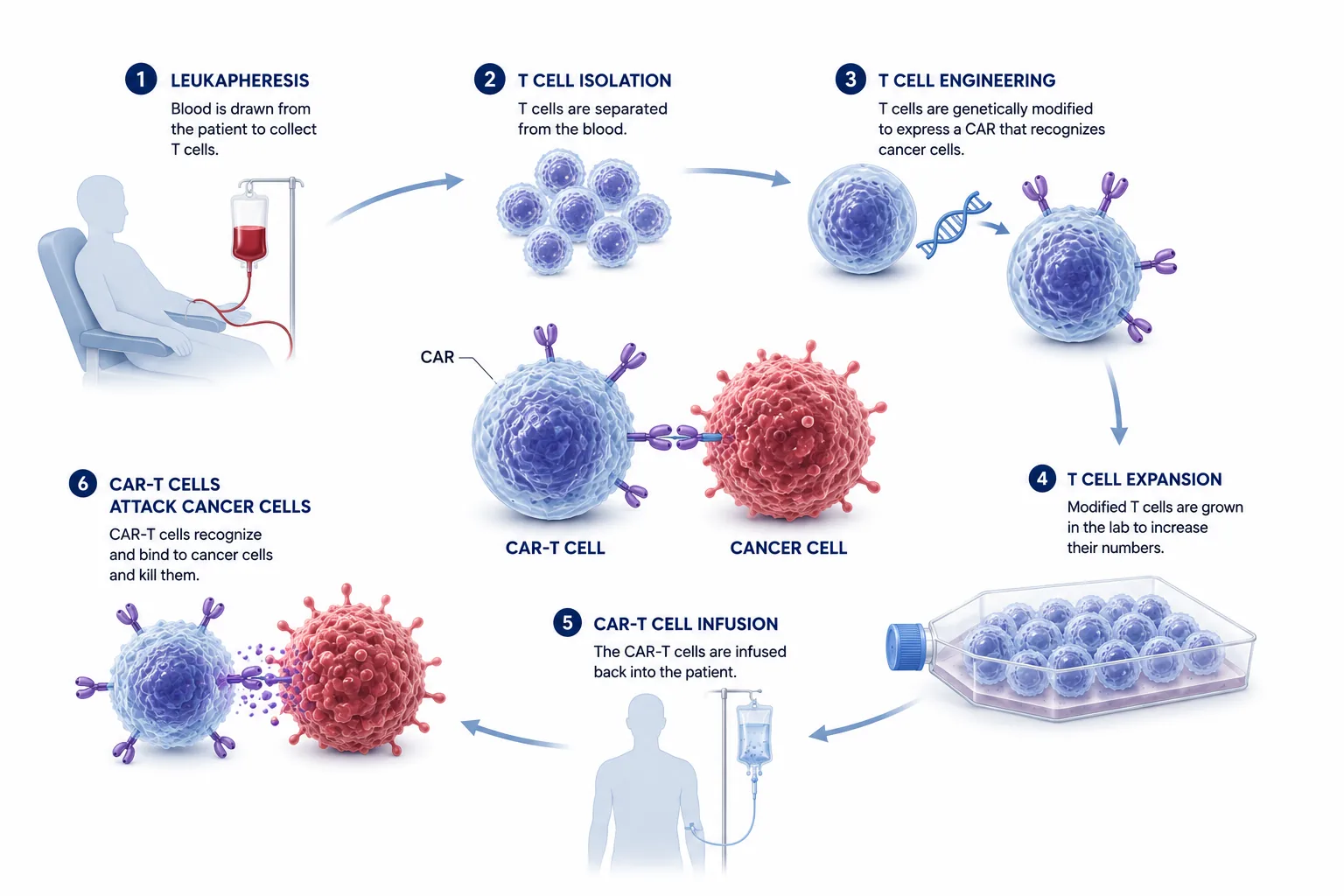
CAR-T and advanced cell therapy planning requires diagnosis, target testing, prior treatment history, hospital review, and monitoring plans.
Quick Answer
China has established and emerging CAR-T and cell-therapy pathways that may be relevant to selected international patients when the diagnosis, target profile, prior treatment history, current disease status, and hospital review criteria align. These include approved hematology CAR-T pathways and emerging solid-tumor developments in selected indications.
As an early planning estimate, CAR-T or advanced hematology pathways in China may range from approximately USD $55,000-$278,000+, depending on product type, hospital, and clinical situation. Published estimates for some commercial NMPA-approved CAR-T products often fall in the USD $55,000-$80,000 range for the drug and hospital stay, while additional pathway costs such as testing, bridging therapy, monitoring, complications, travel, and caregiver support can extend the total significantly.
For international patients, the most useful first step is not asking whether CAR-T exists in China. It is asking whether this exact case is review-ready and whether the diagnosis, pathology, target expression, prior treatment history, current disease status, and organ function can be matched to a relevant China-based pathway.
Key Takeaways
- China has credible and fast-developing CAR-T and cell-therapy capabilities in selected institutions and treatment areas.
- CAR-T eligibility is case-specific and depends on diagnosis, pathology, prior treatment, disease status, and target expression when relevant.
- CAR-T budgets are highly variable; early planning range may be around USD $55,000-$278,000+.
- The pathway may include remote review, testing, travel decision, T-cell collection, manufacturing or preparation, infusion, monitoring, and follow-up.
- CareNavigator can help patients organize the question and coordinate review, but eligibility and treatment decisions belong to qualified doctors and responsible medical institutions.
What CAR-T In China May Mean For International Patients
For international patients, CAR-T in China may mean several different things. It may refer to approved hematology CAR-T products, hospital-based hematology pathways, clinical research pathways, or newer solid-tumor CAR-T developments in selected indications.
China's cell-therapy field has grown quickly, and recent China Advanced Treatment Updates suggest that certain China-based pathways are becoming more relevant to international patients. This includes developments in Claudin18.2-targeted CAR-T for gastric or gastroesophageal junction cancer and reports of international-patient pathway activity at selected institutions.
The practical question is specific: can this patient's diagnosis, pathology, target expression, prior treatment history, current disease status, and travel readiness be matched to a relevant China-based pathway for review? That is where a broad news headline becomes a case-specific planning question.
Early Planning Cost Range For CAR-T In China
As an early planning estimate, CAR-T or advanced hematology pathways in China may range from approximately USD $55,000-$278,000+, depending on product type, hospital, and clinical situation. Published estimates for some commercial NMPA-approved CAR-T products often fall in the USD $55,000-$80,000 range for the drug and hospital stay, while additional pathway costs such as testing, bridging therapy, monitoring, complications, travel, and caregiver support can extend the total significantly.
CAR-T budgets can be highly case-specific because the treatment process can involve more than the cell product itself. Costs may be affected by target testing, specialist review, hospital stay, T-cell collection, manufacturing or preparation, bridging therapy, pre-infusion treatment, infusion, infection management, side-effect monitoring, ICU risk, medications, follow-up, accommodation, travel, and caregiver support.
| Cost factor | Why it matters |
|---|---|
| Therapy or product type | Different CAR-T pathways may have different product, hospital, and monitoring costs |
| Diagnosis and target | Some pathways require specific target-expression testing or disease features |
| Prior treatment history | Prior lines of therapy can affect eligibility and bridging needs |
| Hospital stay | Monitoring and inpatient care may affect total cost |
| Complications or toxicity management | Infection, immune-related reactions, or ICU risk can change the budget |
| Bridging therapy | Some patients may need treatment before CAR-T infusion |
| Follow-up | Post-infusion monitoring and return-care coordination should be planned |
| Travel and companion support | International patients must also budget for flights, stay, caregiver needs, and local logistics |
Eligibility Checklist For CAR-T Review
Before asking whether CAR-T in China may be relevant, patients should prepare a review-ready case file.
Useful information includes:
- Confirmed diagnosis
- Pathology report
- Target expression testing if relevant, such as Claudin18.2, CD19, BCMA, or other markers depending on the disease and pathway
- Prior lines of therapy
- Treatment response and progression history
- Recent imaging reports and DICOM files
- Current disease status
- Organ function and recent labs
- Infection status if available
- Current medications
- Current treatment summary
- Treating physician note if available
- Any urgent symptoms or travel limitations
The goal is not to prove eligibility yourself. The goal is to make the case readable enough for qualified medical teams to review.
Typical China CAR-T Pathway Stages
| Stage | What it means | Patient planning note |
|---|---|---|
| Records preparation | Gather diagnosis, pathology, imaging, prior treatment, and current status | Incomplete records can delay meaningful review |
| Remote review | A medical team reviews whether the pathway may be worth exploring | This is not the same as acceptance or eligibility confirmation |
| Target testing | Biomarker or target-expression testing may be needed | Testing requirements depend on disease and pathway |
| Travel decision | Patient and family assess feasibility after review | Travel readiness and medical stability matter |
| T-cell collection | Cells may be collected if the pathway proceeds | Timing depends on hospital review and clinical condition |
| Manufacturing or preparation | Cells are processed before infusion | Timing can vary by product, hospital workflow, and case needs |
| Pre-infusion treatment if needed | Some patients may need bridging or conditioning treatment | This can affect cost and timeline |
| Infusion | CAR-T product is infused under medical supervision | Requires treating-team decision and monitoring plan |
| Monitoring | Patient is monitored for side effects, infection, or complications | Monitoring needs can vary significantly |
| Follow-up | Ongoing review and coordination after treatment | Home-country follow-up should be planned early |
No timeline should be assumed from this table. Timing depends on diagnosis, hospital pathway, patient condition, product availability, clinical judgment, and travel readiness.
What Recent China Updates Suggest
Recent China Advanced Treatment Updates are important because they show that China's CAR-T and advanced oncology ecosystem is becoming more visible to international patients.
China's approval of a Claudin18.2-targeted CAR-T therapy for advanced gastric or gastroesophageal junction adenocarcinoma created global attention around solid-tumor CAR-T development. A separate Jiahui International Cancer Center update described an international patient pathway that began with T-cell collection after China's approval of solid-tumor CAR-T therapy. Together, these updates make China more relevant for families who are comparing advanced oncology options beyond their home system.
The China Advanced Treatment Updates hub should be read as a signal source, not a one-size-fits-all treatment guide. These updates help families identify what may be worth asking about, while the actual next step is still case-specific review based on diagnosis, target expression, prior treatment history, and current condition.
What Patients Should Clarify Before Moving Forward
The practical question is whether this patient's exact diagnosis, target expression, prior treatment history, and current condition can be matched to a relevant China-based pathway. Product approval, a news report, or another patient's pathway can be useful context, but the actual review has to start with the individual case.
Families should clarify the likely pathway, target-testing requirements, hospital review process, expected monitoring needs, possible bridging treatment, follow-up needs, and early budget category before making travel decisions. CAR-T is a complex pathway that requires medical review, hospital capability, toxicity management, and follow-up planning.
CareNavigator does not determine eligibility, prescribe CAR-T, select a product, or make treatment decisions. CareNavigator helps patients organize information, compare whether China-based options may be worth reviewing, coordinate the review process, and prepare for informed conversations with qualified clinicians.
How The China Treatment Budget Planner Helps
The China Treatment Budget Planner can help families understand the early budget category for CAR-T or advanced hematology pathways before starting deeper review.
Because CAR-T budgets can be highly variable, the planner is most useful as a first planning tool: it helps families understand the scale of the pathway before investing time in a deeper review. If your case is specific, complex, or not listed, you can submit details for manual review.
Use the China Treatment Budget Planner to understand the early budget category before starting a deeper CAR-T pathway review.
Estimate your CAR-T pathway budget
Related China Treatment Cost And Planning Guides
- Compare treatment cost ranges in China
- Proton therapy in China: cost, timeline, and planning
- Estimate your China treatment budget
FAQ
Is CAR-T available in China for international patients?
CAR-T and advanced cell-therapy pathways are available in China in selected treatment areas and institutions. International-patient relevance depends on diagnosis, pathway availability, hospital review, clinical suitability, records, target expression when relevant, and travel readiness.
How much does CAR-T treatment in China cost?
As an early planning range, CAR-T or advanced hematology pathways in China may be around USD $55,000-$278,000+. The final budget depends on product/pathway type, hospital stay, monitoring, bridging therapy, complications, ICU risk, follow-up, travel, and caregiver support. This is an early planning range, not a hospital quote.
Is solid-tumor CAR-T available for every cancer?
No. Solid-tumor CAR-T remains highly specific by target, indication, product, institution, and patient condition. Recent China updates are important, but they should not be read as general availability for every solid tumor.
What records are needed for CAR-T review?
Important records include confirmed diagnosis, pathology, target-expression testing if relevant, prior treatment history, imaging, current disease status, organ function, infection status, current medications, and a treating physician note if available.
Can CareNavigator tell me if I am eligible?
CareNavigator can help organize your case and coordinate review with appropriate medical providers. Eligibility must be assessed by qualified clinicians and responsible medical institutions. CareNavigator does not make medical eligibility decisions.
What is T-cell collection?
T-cell collection is a step in some CAR-T pathways where a patient's T cells are collected for later processing or preparation. Whether and when this step happens depends on the treatment pathway, hospital review, product availability, and patient condition.
Next Step
If you are considering CAR-T treatment in China, start by organizing your diagnosis, pathology, imaging, prior treatment history, and target-expression results if available. CareNavigator can help you understand whether a China-based CAR-T or advanced oncology pathway may be worth reviewing and coordinate next steps with appropriate medical providers.
Start with the Budget Planner